

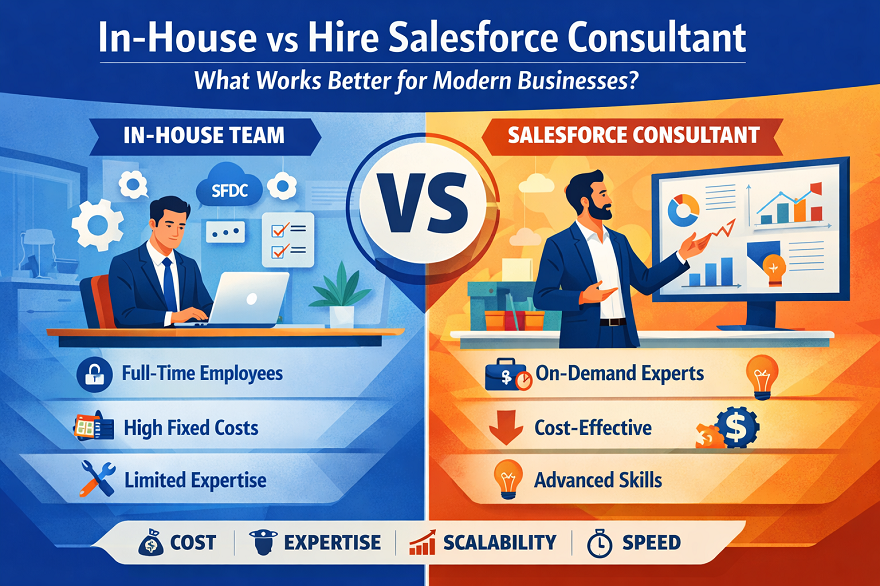
Salesforce has become the backbone of customer relationship management for modern businesses. From sales automation and customer support to analytics and AI-driven insights, Salesforce offers powerful capabilities—but only when implemented and managed correctly.
As organizations grow, a critical question arises: Should you build an in-house Salesforce team or hire a Salesforce consultant? Each model has its advantages, and the right choice depends on business size, complexity, and long-term goals.
This article breaks down both approaches to help modern businesses make an informed decision.
Understanding the Two Models
In-House Salesforce Team
An in-house Salesforce team typically includes a Salesforce Administrator, Developer, and sometimes an Architect. These professionals work exclusively for the organization, managing day-to-day CRM operations, customizations, and internal requests.
Companies usually adopt this model when Salesforce is deeply embedded in daily operations and there is a continuous workload that justifies full-time resources.
Hiring a Salesforce Consultant
When businesses hire a Salesforce consultant, they gain access to external experts who specialize in Salesforce implementation, customization, integration, and optimization. Consultants may work as freelancers, part of an agency, or through certified Salesforce consulting partners.
This model is often project-based or flexible, allowing companies to scale resources as needed.
Cost Comparison: In-House vs Hire Salesforce Consultant
Building an in-house team involves more than just salaries. Recruitment costs, employee benefits, training, certifications, and infrastructure all add to the long-term investment. Additionally, keeping up with Salesforce’s frequent updates requires continuous learning.
On the other hand, when businesses hire Salesforce consultants, they pay only for the expertise they need. While consultant fees may seem higher initially, they often reduce overall costs by avoiding long-term commitments and minimizing costly mistakes.
Expertise and Skill Depth
An in-house team may have strong knowledge of internal processes but is often limited in exposure to diverse Salesforce use cases. Complex implementations involving multiple clouds, third-party integrations, or industry-specific requirements can stretch internal capabilities.
Salesforce consultants bring cross-industry experience and proven best practices. Their exposure to multiple projects enables them to anticipate challenges and deliver optimized solutions faster.
Scalability and Flexibility
Scaling an in-house team requires time and budget approval for new hires. This can slow down projects during periods of rapid growth or change.
When businesses hire Salesforce consultants, scaling becomes easier. Organizations can increase or decrease resources based on project demands, seasonal workloads, or strategic initiatives—without long-term obligations.
Speed of Implementation and Time-to-Value
Hiring and onboarding in-house Salesforce talent can take months. During this time, CRM initiatives may stall or underperform.
Experienced Salesforce consultants follow established frameworks and accelerators, enabling faster implementations and quicker time-to-value. This speed is critical for businesses aiming to stay competitive in dynamic markets.
Risk Management and Compliance
Salesforce implementations carry risks, including poor data architecture, security misconfigurations, and low user adoption. In-house teams with limited experience may struggle to mitigate these risks effectively.
Consultants reduce risk by leveraging standardized methodologies, security best practices, and compliance-aware configurations—ensuring stable and scalable CRM environments.
Ongoing Support and Innovation
Salesforce releases new features three times a year. Keeping systems optimized and aligned with evolving business needs requires continuous innovation.
In-house teams often focus on maintenance, leaving little time for optimization. Salesforce consultants, however, proactively recommend enhancements, automation, and AI-driven improvements to maximize platform value.
Read Our Latest Blog- ZeroGPT Free AI Detector – Human or AI Content Checker Online
Which Option Works Best for Modern Businesses?
- Startups and SMBs benefit most when they hire Salesforce consultants due to cost efficiency and access to expert guidance.
- Mid-market companies often adopt a hybrid approach, combining in-house administrators with external consultants.
- Enterprises may maintain large internal teams but still hire Salesforce consultants for complex projects or digital transformation initiatives.
Conclusion
There is no one-size-fits-all answer when choosing between an in-house team and hiring a Salesforce consultant. While in-house teams offer internal alignment, consultants provide flexibility, speed, and deep expertise—qualities that modern businesses increasingly require.
For organizations seeking scalable, secure, and future-ready Salesforce solutions, partnering with an experienced consulting firm can be a strategic advantage. Melonleaf Consulting helps businesses bridge the gap between Salesforce technology and business outcomes by delivering tailored CRM solutions, expert guidance, and ongoing optimization support.

