

Introduction
Cell culture technology sits at the heart of modern life science research, biopharmaceutical manufacturing, diagnostics, and regenerative medicine. From academic laboratories studying basic cellular mechanisms to large-scale facilities producing vaccines and monoclonal antibodies, the ability to grow, maintain, and manipulate cells in controlled environments is essential. Two critical components enable this work: cell culture media and single-use reagents. Together, they provide the nutrients, environmental support, and experimental consistency required to ensure reliable and reproducible results.
Definition
Cell culture media and single-use reagents are sterile, ready-to-use solutions and consumables designed to support the growth, maintenance, and manipulation of cells in vitro. They include nutrient-rich media, supplements, buffers, enzymes, and other reagents that are used once and discarded to minimize contamination, ensure consistency, and maintain reproducibility in research, biomanufacturing, and clinical laboratory applications.
Understanding Cell Culture Media
Cell culture media are specially formulated solutions designed to support the growth, survival, and function of cells outside their natural environment. Since cells removed from tissues no longer have access to the body’s complex regulatory systems, culture media must replicate key physiological conditions as closely as possible.
Key Components of Cell Culture Media
Most cell culture media contain a combination of the following elements:
- Amino acids to support protein synthesis and cellular metabolism
- Carbohydrates, primarily glucose, as an energy source
- Vitamins that act as enzymatic cofactors
- Salts and buffers to maintain osmotic balance and stable pH
- Growth factors and hormones to stimulate proliferation and differentiation
In many traditional formulations, serum – most commonly fetal bovine serum (FBS) – has been used to supply growth factors and binding proteins. However, concerns over variability, ethical sourcing, and contamination have driven a strong shift toward serum-free and chemically defined media.
Types of Cell Culture Media
Cell culture media can be broadly classified based on their complexity and intended application:
- Basal media, such as DMEM or RPMI-1640, provide essential nutrients but often require supplementation.
- Complete media include basal media plus serum or defined supplements.
- Serum-free media reduce variability and improve reproducibility.
- Chemically defined media contain only known components, which is critical for regulatory compliance in biopharmaceutical manufacturing.
- Specialty media are tailored for specific cell types, such as stem cells, hybridomas, or primary cells.
The choice of media significantly impacts cell behavior, productivity, and experimental outcomes, making careful selection a key step in any cell culture workflow.
The Role of Single-Use Reagents
Single-use reagents are pre-prepared, disposable solutions or materials designed for one-time use in laboratory and manufacturing processes. These include buffers, enzymes, media supplements, transfection reagents, and filtration units.
The adoption of single-use reagents has accelerated in recent years due to their ability to improve efficiency, reduce contamination risks, and simplify operations.
Advantages of Single-Use Reagents
- Reduced Contamination Risk
Using reagents only once minimizes the chance of cross-contamination between experiments or production batches, which is especially important in sterile cell culture environments. - Improved Reproducibility
Pre-formulated and quality-controlled reagents help ensure consistency across experiments, laboratories, and manufacturing sites. - Time and Labor Savings
Ready-to-use reagents eliminate the need for in-house preparation, filtration, and validation, allowing scientists to focus on experimental design and analysis. - Regulatory Compliance
In regulated industries such as biopharmaceutical manufacturing, single-use reagents support compliance by offering traceability, documentation, and lot-to-lot consistency. - Scalability and Flexibility
Single-use systems can be easily scaled up or down, making them ideal for both early-stage research and commercial production.
Synergy Between Media and Single-Use Reagents
Cell culture media and single-use reagents work together to create streamlined and reliable workflows. For example, chemically defined media combined with single-use supplements and buffers enable tightly controlled culture conditions. This synergy is particularly valuable in applications where even minor variability can impact outcomes, such as cell therapy development or vaccine production.
Single-use media bags, bottles, and mixing systems further enhance efficiency by reducing cleaning and sterilization requirements. This approach not only lowers operational costs but also shortens turnaround times between production runs.
Applications Across Industries
Biopharmaceutical Manufacturing:
In the production of monoclonal antibodies, recombinant proteins, and vaccines, optimized cell culture media directly influence yield and product quality. Single-use reagents and systems support rapid process development and reduce the risk of batch failure.
Cell and Gene Therapy:
Cell and gene therapies require precise control over cell phenotype and function. Serum-free, chemically defined media combined with single-use transfection and expansion reagents are essential for meeting strict safety and regulatory standards.
Academic and Clinical Research:
In research laboratories, single-use reagents provide convenience and consistency, while specialized media support the culture of challenging cell types, including primary cells and induced pluripotent stem cells (iPSCs).
Diagnostics and Testing:
Cell-based assays used in diagnostics rely on reproducible culture conditions. Single-use reagents ensure standardized testing environments, improving the reliability of results.
Trends and Future Directions
The field of cell culture is evolving rapidly, driven by advances in biotechnology and increasing regulatory expectations. Key trends include:
- Greater adoption of animal-component-free media to improve safety and ethical sourcing
- Integration of single-use technologies across entire manufacturing workflows
- Customization of media formulations using data-driven optimization and artificial intelligence
- Sustainability initiatives, such as recyclable materials and reduced waste in single-use systems
As personalized medicine and advanced therapies continue to grow, demand for high-performance media and reliable single-use reagents will only increase.
Growth Rate of Cell Culture Media and Single-Use Reagents Market
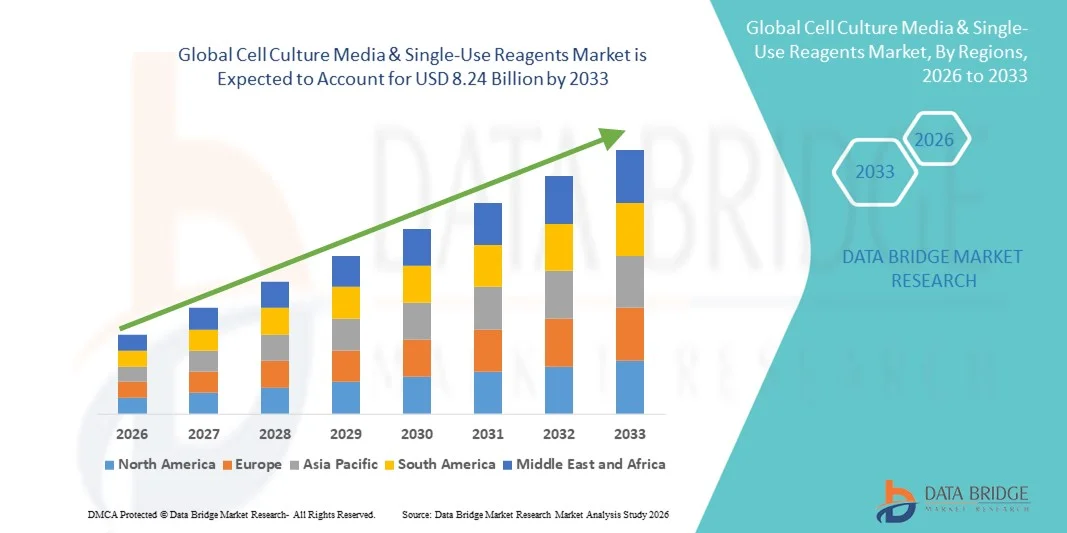
According to Data Bridge Market Research, the cell culture media & single-use reagents market was estimated to be worth USD 4.11 billion in 2025 and is projected to grow at a compound annual growth rate (CAGR) of 9.10% to reach USD 8.24 billion by 2033.
Learn More: https://www.databridgemarketresearch.com/reports/global-cell-culture-media-and-single-use-reagents-market
Conclusion
Cell culture media and single-use reagents form the backbone of modern life science research and biomanufacturing. By providing the necessary nutrients, environmental control, and operational efficiency, they enable scientists and manufacturers to achieve consistent, high-quality results. The shift toward chemically defined media and single-use solutions reflects a broader industry focus on reproducibility, safety, and scalability.