

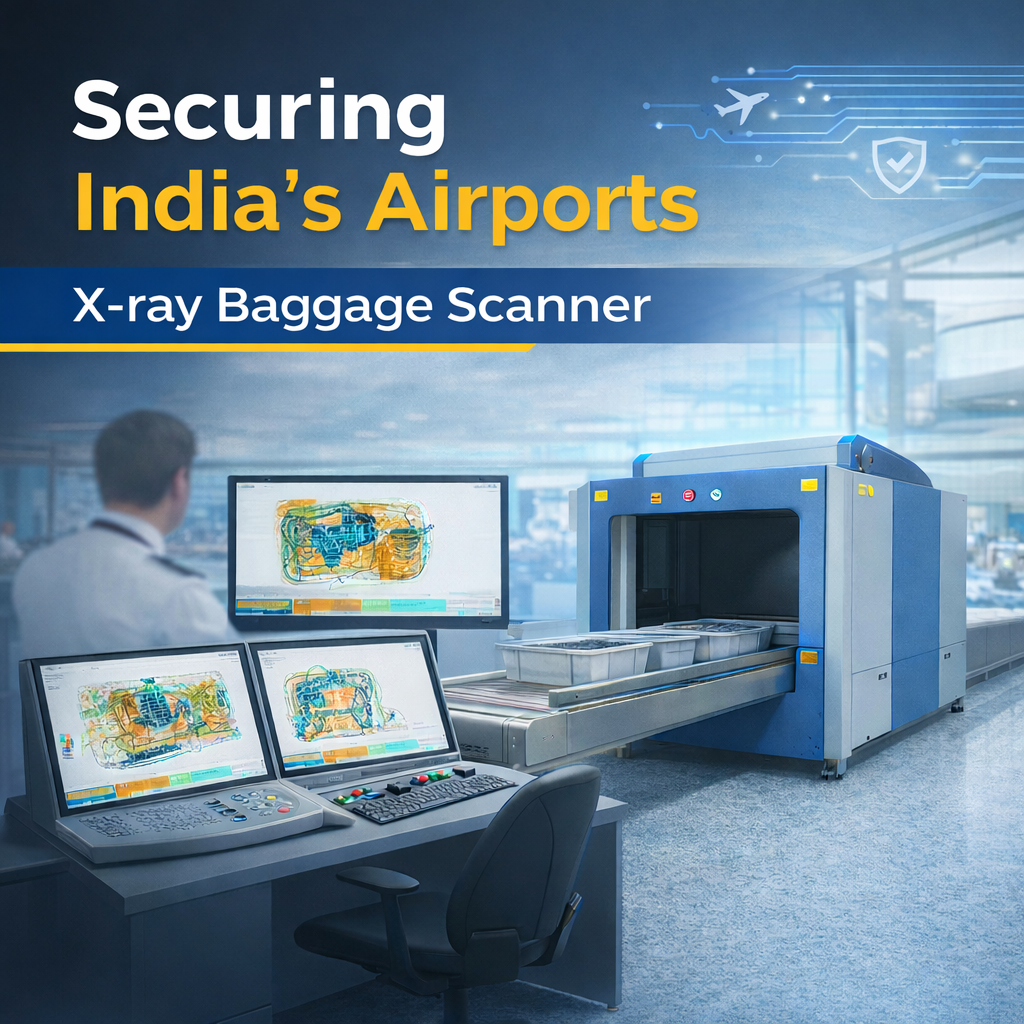
In an era of exponential travel growth and evolving security challenges, ensuring that India’s airports remain safe and efficient has never been more critical. Krystalvision Imaging Pvt Ltd, a leader in security imaging solutions, is at the forefront of equipping the nation’s aviation hubs with X Ray Baggage Scanner technology. As passenger numbers soar and global threats become more sophisticated, investment in advanced scanning systems is indispensable for safeguarding people and infrastructure alike. This article explores the role and impact of modern X-ray baggage scanner systems, the rise of X-ray baggage scanner in india deployment, and what this means for the future of Indian airport security.
1. The Aviation Boom and Security Imperatives in India
India’s aviation landscape is witnessing unprecedented expansion. With more than 400 airports, including new greenfield projects and regional connectivity initiatives under UDAN (Ude Desh ka Aam Naagrik), passenger throughput is set to climb further. According to IATA projections, India could become the world’s third-largest aviation market by the end of this decade. This rapid increase in air travel has placed immense pressure on airport security units to manage large volumes of baggage without compromising safety or passenger convenience.
At the heart of this security infrastructure is the X-Ray Baggage Scanner, a reliable and fast tool for inspecting carry-on and checked luggage. Airports across metropolitan and tier II/III cities alike are upgrading their scanning capabilities to match the pace of growth and evolving threat paradigms.
2. Understanding Advanced X-Ray Baggage Scanners
X Ray Baggage Scanner technology has matured significantly from the rudimentary systems of the past. Today’s scanners use dual energy or multi-energy imaging to differentiate between organic and inorganic materials, enabling security personnel to quickly identify potential threats such as explosives, weapons, or contraband. Additionally, advanced algorithms and artificial intelligence (AI) enhancements help reduce false alarms and improve threat detection accuracy.
These scanners are not just tools; they are the backbone of the layered security strategy that airports employ to keep passengers safe. Modern devices provide high-resolution, 3D imaging that allows operators to rotate and examine suspicious items from various angles without unpacking the bag, saving time and improving throughput.
3. The Importance of Domestic Capability: Baggage Scanner Manufacturers in India
While international players have traditionally dominated the security imaging market, there is a growing emphasis on indigenous manufacturing and technological self-reliance. The Indian government’s Make in India initiative has catalyzed investment in building domestic capability for critical security equipment, including baggage scanner manufacturers in India.
Local manufacturing not only reduces dependency on imports but also fosters innovation tailored to India’s unique operational environments, from crowded metros to remote regional airports. Domestic manufacturers are now better positioned to offer maintenance, support, and customization, which are vital for sustained efficiency and reliability.
Krystalvision stands out among these innovators. With deep expertise in X-ray imaging and a commitment to quality, the company has contributed significantly to the rollout of advanced scanning equipment in airports, seaports, government facilities, and other critical infrastructure locations.
4. Meeting Diverse Needs: Baggage Scanner Machine India Options
The diversity of India’s airport infrastructure, from large international hubs to smaller regional terminals, demands a flexible range of solutions. Baggage scanner machine India offerings vary in size, imaging resolution, conveyor capacity, and throughput speed to meet these varied requirements.
High-voltage systems with larger tunnel dimensions are ideal for checked baggage at major airports, while compact, high-speed units serve smaller terminals and security checkpoints effectively. Advanced models integrate seamlessly with automated sorting systems, enabling quicker processing and reduced manual intervention.
Moreover, enhancements such as threat image projection (TIP) and automated threat detection increasingly augment human operator performance, boosting overall security levels. Vendors in India are continually refining their products to meet stringent regulatory standards while addressing user feedback from frontline operators.
5. Choosing Reliable X-Ray Baggage Scanner Companies in India
Selecting the right partner is crucial for airport authorities and security integrators. X-ray baggage scanner companies in India must demonstrate not only modern technology but also robust after-sales support, training programs, and compliance with international safety standards.
Krystalvision has carved a niche in this competitive landscape. Its comprehensive portfolio includes advanced scanning systems, maintenance services, software upgrades, and operator training modules. With a strong focus on research and development, the company continues to push the boundaries of what is possible in security imaging.
Strong local presence also ensures that technical assistance is timely, a critical factor in environments where downtime can disrupt operations and impede passenger flow.
6. Enhancing Airport Security Workflows with Technology Integration
Modern airport security is a symphony of interconnected systems from credential checks and biometric access points to baggage imaging and real-time threat monitoring. Integrating X-ray baggage scanner outputs with central command and control systems enhances situational awareness and enables rapid decision-making.
For example, when a scanner identifies a potential threat, the image data can be routed to remote experts or central security operations centers for further analysis. This reduces bottlenecks and ensures that security personnel are not solely reliant on local interpretations, which can vary depending on experience or workload.
Such integration also supports data logging and audit trails, essential for regulatory compliance and post incident analysis. These features are particularly beneficial in large airports handling thousands of bags per hour.
7. Building Human Capacity Alongside Technological Advancements
Technology alone cannot secure skies; well-trained professionals must operate and interpret scanning systems effectively. As India’s airport security apparatus modernizes, there is a parallel need to invest in human capital.
Manufacturers like Krystalvision often conduct extensive training sessions for operators, helping them understand system functionalities, interpret complex images, and respond appropriately to alerts. Ongoing training programs that incorporate the latest threat profiles and emerging techniques ensure that personnel remain sharp and prepared.
Moreover, user-friendly interfaces and ergonomic designs in modern scanners reduce operator fatigue and error rates, contributing to overall effectiveness.
8. Addressing Operational Challenges in India
Deploying advanced scanning technology in India comes with its own set of challenges. High passenger volumes, diverse baggage types, and infrastructure constraints at legacy airports require advanced solutions. Additionally, environmental factors such as heat and dust in some regions necessitate ruggedized equipment that can perform reliably under harsh conditions.
To address these challenges, airports need to work with vendors who understand both global best practices and local operational realities. This includes custom configurations, enhanced maintenance contracts, and rapid response teams that can minimize downtime.
Krystalvision’s projects across various Indian airports reflect this adaptive approach, marrying international standards with pragmatic deployment strategies for optimal performance.
9. Looking Ahead: Future Ready Scanning Solutions
The future of airport security lies in smarter, faster, and more adaptive systems. Technologies like computed tomography (CT) scanning, AI-driven threat detection, and automated decision support are gradually becoming mainstream in advanced security architectures.
As these technologies mature, they promise greater detection accuracy, reduced false positives, and streamlined passenger experiences. India’s aviation sector is poised to adopt these innovations, and domestic players are well placed to contribute meaningfully to this transformation.
For Krystalvision and other pioneers, the mission is clear continue developing and delivering technologies that secure India’s skies while supporting the nation’s booming aviation aspirations.
10. Conclusion: Securing India’s Airports with Confidence
India’s airports are gateways to opportunity, commerce, and cultural exchange. Ensuring these gateways are secure is a shared responsibility that hinges on the effective deployment of advanced X-ray baggage scanner systems, skilled personnel, and forward-looking security strategies. From boosting detection capabilities to enabling seamless travel experiences, modern baggage screening technology is vital to this mission. The emergence of strong baggage scanner manufacturers in India and the contributions of X-ray baggage scanners in India deployments underscore the progress being made. With trusted partners like Krystalvision leading the way, India is building a resilient and technologically sophisticated aviation security ecosystem ready for the challenges of today and tomorrow