
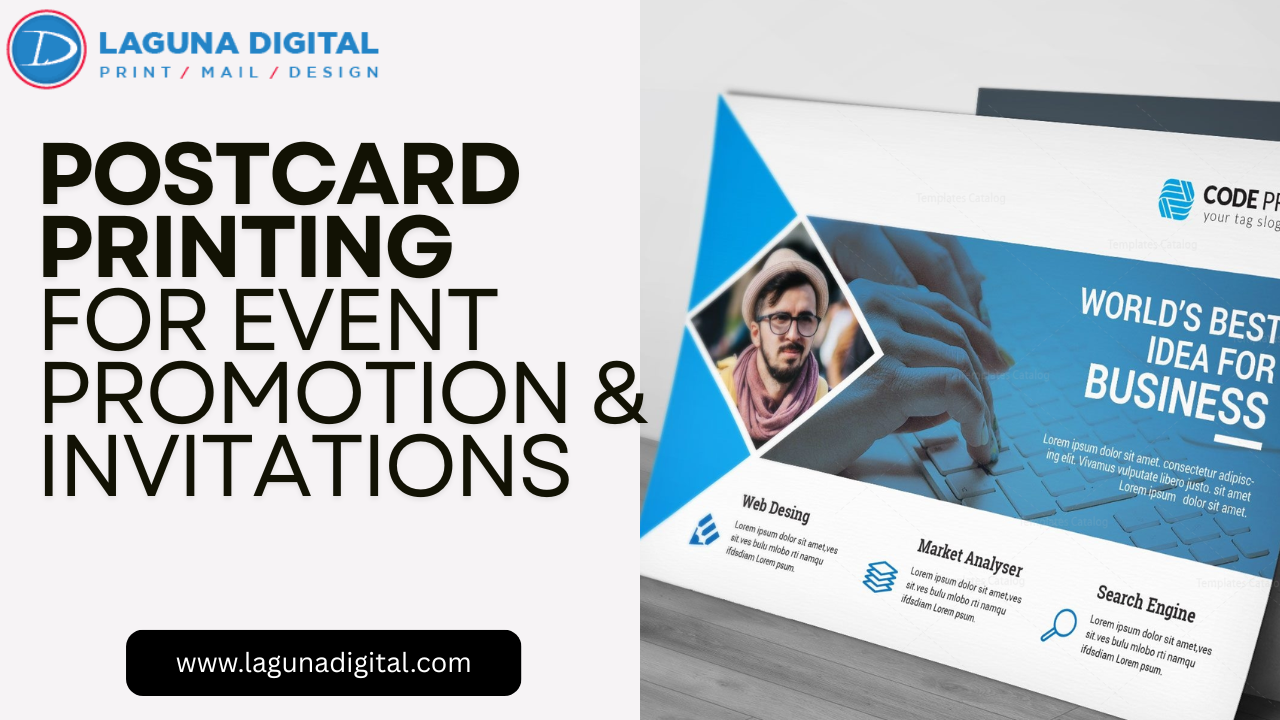
There is a distinct difference between clicking Interested on a social media event page and holding a beautifully textured, weighted invitation in your hand. As someone who has spent years in the printing industry, I have seen clients pour their hearts into planning galas, store openings, and weddings, only to rely solely on email invites that end up in the spam folder. It is heartbreaking to watch a great event suffer from low attendance simply because the invitation didn’t feel real to the recipient.
In our digital-first world, physical mail has regained its status as a luxury. It signals effort, investment, and importance. When you utilize high-quality Postcard Printing, you aren’t just sending a date and time; you are sending a physical promise of an experience. Whether you opt for standard sizes or unique die-cut shapes, the goal is to disrupt the recipient’s daily routine and make them feel genuinely welcome.
At Laguna Digital, we often tell our clients that the invitation is the first course of the event meal. It sets the flavor. If the paper is flimsy or the colors are dull, people subconsciously lower their expectations for the event itself. Conversely, a stunning, tactile postcard creates anticipation and excitement that digital notifications simply cannot replicate.
The Psychology of Physical Invitations
Why Tactile Marketing Drives Attendance
We live in an age of digital fatigue. My clients often tell me they are overwhelmed by the sheer volume of emails they receive daily. A physical postcard breaks that pattern. When a person walks to their mailbox and pulls out a card, they are engaging multiple senses sight and touch. This multisensory experience creates a stronger memory encoding in the brain compared to a fleeting glance at a screen.
This “stickiness” is vital for event attendance. An email is easily archived and forgotten, but a well-designed postcard often ends up on a refrigerator or a desk bulletin board. It serves as a constant visual reminder of your upcoming event. This is why tangible marketing materials continue to outperform digital-only strategies when it comes to RSVP rates for high-stakes events.
Building Legitimacy and Trust
There is also the factor of legitimacy. Anyone can create a Facebook event in thirty seconds for free. Printing and mailing physical invitations requires budget and effort, which signals to your audience that this event is legitimate and worth their time. This is particularly true for corporate functions, fundraisers, and grand openings where you need to impress stakeholders or potential VIPs.
Designing Postcards That Demand Attention
Visual Hierarchy and Imagery
A common mistake I see is the “kitchen sink” approach—trying to cram every single detail onto a 5×7 card. Effective design requires breathing room. Your postcard should feature a captivating headline and high-quality imagery that captures the mood of the event. If you are showcasing a venue or a product launch, professional photo printing ensures that your images look crisp and vibrant, rather than muddy or pixelated.
The text should follow a clear hierarchy: The “What,” “When,” and “Where” must be instantly readable. Secondary details can be smaller. If you are struggling with layout, I highly recommend looking into tips for effective postcard design to understand how the human eye scans printed material. A confused mind usually decides not to attend, so keep it clean and direct.
Paper Stock and Finishes matter
I cannot stress this enough: the paper stock is the handshake of your event. If it feels limp, it feels cheap. For invitations, I almost always recommend a heavier card stock something that has a “thud” when you drop it on a table. Beyond weight, consider the finish. A matte finish feels sophisticated and modern, while a high-gloss finish brings energy and vibrancy.
For those looking to make a massive impact, premium printing techniques like foil stamping or spot UV coating can add a layer of luxury. Imagine a wedding invite where the names catch the light in gold foil, or a corporate gala invite where the logo is raised and glossy against a matte background. These details matter.
Integrating Print with Digital RSVP Strategies
Bridging the Gap with Technology
While I champion print, I am also a realist. We live in a digital world, and managing RSVPs via mail-back cards can be slow and expensive. The solution? Smart printing services. By incorporating a QR code into your postcard design, you give the recipient the best of both worlds: the elegance of a physical invite and the convenience of a one-click digital RSVP.
This approach also allows you to track the effectiveness of your campaign. You can see exactly when people received the cards and scanned the code. It turns a static piece of paper into an interactive gateway. This strategy borrows heavily from successful retail campaigns, where promotional printing strategies are used to drive online traffic from offline sources.
Consistency Across Event Collateral
Your postcard shouldn’t exist in a vacuum. It should be the first piece of a cohesive visual puzzle. When your guests arrive at the event, the banners, posters, and signs should match the design of the invitation they received weeks ago. This visual continuity reinforces branding and makes the event feel professionally produced.
Furthermore, consider what happens during the event. Are you handing out programs or agendas? Professional book printing for event booklets that match your postcard invitations creates a polished, high-end experience from the first mailbox moment to the final farewell.
Common Mistakes to Avoid
Timing is Everything
The biggest tragedy in event planning is the “too late” mailer. Postcards take time to design, print, and travel through the postal system. I always advise clients to work backward from the event date. For a casual event, 3-4 weeks out is fine. For a formal event or wedding, you want those cards in hands 6-8 weeks prior. Rushing leads to stress and mistakes.
Neglecting the “Business Essentials”
Sometimes we get so caught up in the “fun” part of the event design that we forget the business essentials that support it. Did you print return address labels? Do you have branded envelopes if you aren’t mailing the card “naked”? Did you proofread the date? I have seen thousands of beautiful cards reprinted because someone typed “2024” instead of “2025.” Always double-check your basics.
Overlooking the Power of Digital Printing
Some clients assume that to get high quality, they need to order 10,000 units on an offset press. That is no longer true. Modern digital printing technology allows for short runs with incredible quality. This means you can print 50 invites for a private dinner or 500 for a local fundraiser without breaking the bank or sacrificing image fidelity.
FAQs
1. How far in advance should I mail postcards for an event?
For local business events or sales, 2-3 weeks is usually sufficient. For weddings, galas, or events requiring travel, aim for 6-8 weeks. If you are sending “Save the Dates,” those should go out 4-6 months in advance.
2. Is it better to mail postcards with or without envelopes?
For a casual, high-volume promotional event (like a store opening), mailing a “naked” postcard is cost-effective and ensures immediate visibility. For formal events (weddings, awards dinners), an envelope is necessary to protect the card and convey a sense of formality.
3. What is the best size for an event invitation?
The standard 4×6 is the most affordable for postage, but it can get lost in the mail pile. A 5×7 is the standard “invitation size” and commands more attention. For truly special events, a 6×9 oversized postcard is impossible to ignore but will cost more in postage.
4. Can I personalize each postcard with the guest’s name?
Yes! using variable data printing (VDP), we can print the recipient’s name directly on the card (e.g., “We can’t wait to see you, Sarah!”). This significantly increases engagement and makes the recipient feel personally valued.
5. What is the difference between matte and soft-touch finish?
Matte is a non-reflective finish that is smooth and easy to read. Soft-touch is a specialty laminate that feels like velvet or suede to the touch. It creates an immediate subconscious reaction of “luxury” and is excellent for premium events.
Conclusion
At the end of the day, an event invitation is an opening act. It sets the stage for everything that follows. In my years of working with businesses and event planners, I have never seen a digital invite create the same emotional resonance as a beautifully printed, heavy-stock postcard. It tells your guests that they are worth the effort, and that the event is worth their time.
By focusing on strong design, quality materials, and strategic timing, you can turn a simple piece of paper into a powerful tool for driving attendance. Don’t let your big day get lost in an inbox. If you are looking for more insights on how to leverage print for your business or events, be sure to check out our blog for expert advice. Let’s make your next event unforgettable before it even starts.